Archives

Why Transition is the Overwhelming Treatment of Choice

Recently, at a forum where I am involved, a poster asked about evidence for non-transitioning therapies for transsexuals. Now on that forum are a tiny number who consistently pound an anti-transition drum. But as I demonstrated in my reply, their position is not congruent with the position of the medical community today. Here is what I wrote, with minor edits to make it more appropriate for this blog.

__________________________________________________

The AMA is now overwhelmingly on board with fundamental brain differences being the root cause of transsexuality. And the APA (both of them) both state that the most effective therapy statistically for transsexuals is transition.

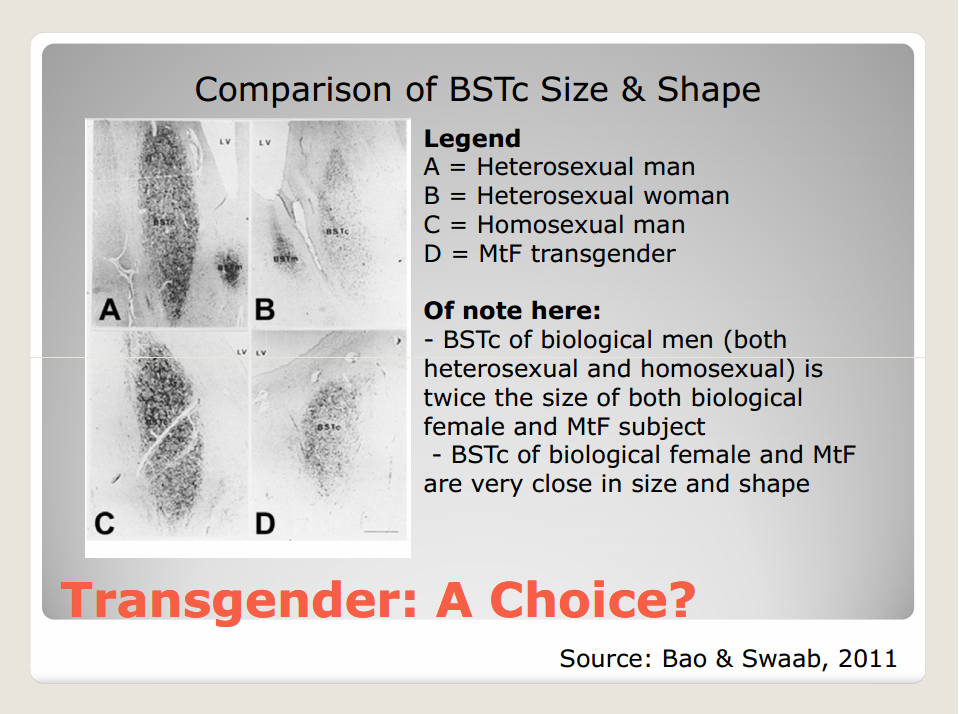
One of the most important of these is brain differences concerns the BST in the hypothalamus. “In the hypothalamus, the bed nucleus of the stria terminalis (BST) is thought to be important for gender identity. One study showed that male-to-female transsexuals had decreased BST staining identical to that for genetic XX female subjects (8). In contrast, genetic XY male subjects had significantly increased BST staining. BST staining was not influenced by sexual orientation or sex hormone levels.”

These differences can be seen below:

MTF_Brain_Scan_differences

In addition, further brain structure differences are being identified as well that impact transsexuals.

This NIH document references the study (by van Kesteren PJ, Gooren LJ, Megens JA. An epidemio-logical and demographic study of transsexuals in The Netherlands. Arch Sex Behav. 1996;25:589–600) that sex reassignment as overwhelmingly statistically successful in addressing the needs of the transsexual community. Given the size of the TS community the size of the study is significant. If the rates of transsexuality are as high as 1 in 600 as has been suggested by various studies, and if 1 in 2500 actually undergo SRS which have been suggested by direct analysis of number of surgeries in the US per year, then the size of the study in question was almost 25% of the SRS population of the Netherlands and 3% of the overall Netherlands TS population. If the rates of transsexuality are lower, then the size of the study is even more significant because it represents an even larger cross section of the TS population!

Here is the NIH position:

Quote

__________________________________________________

Treatment options for patients with gender identity at variance with physical appearance can be evaluated in the order of extent of invasiveness. The least invasive intervention would be counseling such patients to accept the circumstance. As already noted, however, no available data support the success of such therapy. The next least invasive approach might be a targeted treatment of the underlying problem. The medical community, however, has little knowledge about the brain region associated with gender identity, and even less is known about techniques for manipulating it.
Although current transgender treatment is relatively invasive and does not address the problem completely, it is the most successful intervention available. Studies report very high transgender patient satisfaction with sexual reassignment. Thus far, the largest evaluation has been a survey of Dutch transgender patients (10). Among the 1,285 patients surveyed, 1,280 were satisfied.

__________________________________________________

As noted, “no available data support the success” of counseling patients to simply accept their circumstances. The second discussed option, manipulating the brain to become more accepting of the body, is not currently possible because the “medical community, however, has little knowledge about the brain region associated with gender identity, and even less is known about techniques for manipulating it“.

This leaves transitioning as the primary therapy for dealing with GID. As has been noted in the past here, there are people who do manage to live out their lives without transitioning to live in a new gender role. Good for them. But they are also the statistical minority among patients suffering from significant GID. For that category of patients, the number one therapy of choice today is transitioning (aside from suicide and I think we all agree that suicide is a bad option, yes?).

Therapists will assist a patient in trying to meet their personal goals but a transsexual suffering from significant GID ought to be prepared to discover that non-transitioning treatments are very likely to fail to bring them to a level of comfort with themselves that allows them to live a full and fruitful life. Certainly there will be those cases that do succeed at this, but as the NIH document notes, the medical community’s primary treatment therapy today is transition, including HRT, and optionally including surgeries to further assist the body to conform to the expectations of the mind.

Therefore, in answer to the original poster’s question – you are unlikely to find any large scale answer to your question of non-transitioning treatments that work. In almost every case where that does occur, the patient has developed their own unique regimen for coping with their GID that is specific to that patient. The single treatment option that does work and which is medically and statistically supported at this time by the medical and psychiatric and psychological communities is transition.

To the original poster, if you choose to not transition, it’s pretty much you and your therapist in uncharted waters. It’s possible you will succeed. Good luck if you choose that path. I will not dissuade you from taking whatever path you choose but I will stand by the statements in this post that transition is the proven most effective treatment for transsexuals suffering from severe GID.

P.S. This is the reason that there is so-called “cheerleading” for transition in the community – because it works. And because it is overwhelmingly statistically successful. Those are facts.

__________________________________________________

The above was the body of my response in that discussion thread.

Some Religious Arguments Against Gender Surgery Addressed

Recently I commented on an article about Trans Medical Treatment and Faith at Transadvocate. The article began with what one Christian transwoman said about her condition.

“I am trans but also religious. Although I live as a woman, I was born with boy parts. In my opinion, to have surgery would imply that God made a mistake. I do not believe that God is capable of making a mistake, which means that I have the body I was meant to have. I believe that God gave me a challenge and that I am playing the hand that I was dealt. I am trans and proud, but I will not second guess the Almighty. I hope there is room for that, and I love and respect those who believe differently. We are all in this together.”

First, there is always room among us for one to live as they wish and if this woman does not wish gender confirmation surgery (GCS), then she should not seek it. But she should not avoid GCS for incorrect religious reasons. Her argument has several problems and I will dissect those here.

The first problem with this argument is it ignores that babies are born with medical issues every day. From cleft palates to club feet to intersex children to defective hearts to all sorts of other medical issues, the argument that “God doesn’t make mistakes” rings totally hollow. As a pastor I knew once said, this is a fallen world so all sorts of fallen things can occur, even in the womb.

But beyond that are actual Biblical passages that support people being born with problems, not even because of sin, but because that condition can eventually glorify God in some manner, and that Jesus himself accepted those who had voluntarily been castrated (feminized) which is a direct contradiction of the law in Deuteronomy that bans the castrated and their descendants from the temple of the Lord for ten generations.

Here was my comment to the article:

“John 9:1-11 and Matthew 19:11-12. Your Christian friend ought to read both those passages very carefully because they utterly destroy the basis of his argument and both of those passages are from Jesus Christ himself, assuming you accept the New Testament Gospels as accurate, which that person should.”

You need to read those passages to get the full impact but John 9:1-11 is about a man born blind from birth, and Christ reassuring that no one had sinned to cause him to be born blind but that he had been born that way for a purpose of God. Matthew 19:11-12 are about Jesus himself accepting the castrated (feminized) into the kingdom of heaven. So the argument that you shouldn’t do that to your body rings rather hollow when Christ himself accepted people who had surgically altered their genitals.

But beyond that was a wonderful comment from another poster that elaborated even further on this:

“Matthew 19:12 is a reference to Isaiah 56:5, which is clearly a refute of the very early single sentence prohibition in Deut 23:1 against damaging one’s testicles (important for all those Abraham-begets). But then the message in Isaiah and Matthew is again repeatedly referenced and played out very clearly in Acts 26-40. All three time periods, cross referenced. To a Biblical scholar, those three passages stand out as a clear instruction to specifically accept by name, people with intersex conditions, transsexuals and male eunuchs. To a historian, it’s interesting to note that the Church was accepting of eunuchs for much of its early history, even after they were replaced with virtual eunuchs (ie , the vow of chastity) perhaps a thousand years later. Castration’s feminizing effects had been known since the technique was first used on livestock possibly thousands of years prior; it clearly would have been the best available hormone therapy and surgery of the time. Almost as important, though, is that documented ‘eunuchs’ in Rome and elsewhere were recorded as living with the other women, as women. I’m fairly certain they used the (translated) word ‘eunuch’ differently than we do in our post-Freud world.

I’ve met several women who transitioned in the 70’s and 80’s who had their names successfully changed in their local parish Registry. However, that was before the late 1990’s / 2000 when anti-trans Paul McHugh was brought in as the Vatican’s “sex and science adviser”. And clearly before the Pope’s 2007 or 8 Xmas breakfast speech to the Curia regarding “protecting the human ecology”. Accordingly, the bishops have weighed in on issues such as CA’s AB1266 but followed the prior Pope’s position, not Canon, and we don’t know the new Pope’s views.

Perhaps, though, the pendulum is swinging back again:
Transgender Talks Hosted By Two Syracuse Catholic Churches
Parents of Transgender People Share Stories at All Saints Parish

What the careful reader can learn and see very quickly is that the fundamentalist obsession with genitals was not an obsession of the early church or of Christ himself and that surgical alteration of one’s genitals was an accepted thing.

Christians who struggle with this question should, in my opinion, realize that Christ does not care if you have gender surgery or not. It’s not a Biblical issue to torment yourself over. Thus it comes down to one thing and one thing only – do you personally need to do this to be at peace with yourself. If you do, seek the surgery. If you do not, then skip the surgery.

But there is no Christian argument that I can see about gender confirmation surgery (GCS, sometimes referred to as SRS) that should give any trans person pause from aligning their body with their spirit and mind to achieve wholeness.

Whichever choice you make, make it based upon your medical needs, not upon someone else’s interpretation of religious doctrine. You are free to make the choice that you need, whatever choice that is.

Peace be with you, each and every one of you.

Transgender Rights

Recently some questions were asked. Some of these questions were:

A common theme is that if everyone were stealth, then Trans rights would never progress.

Do you agree?

What are examples of Trans rights? Are they special rights for people born Trans?

What does stealth look like to you?

Is stealth possible in 2014 for an adult transitioner?

I did not attempt to answer all of those, just the ones that most interested me. My answer is below.

Trans rights are confirmation of rights that should be accorded to trans people but often are not. As I have explained elsewhere, as explained to me by a lawyer, in the United States, unless a law explicitly covers a group, then that group is not protected.

Case in point – ENDA. Over 80% of Americans believe that discriminating on the basis of gender identity is already illegal because discriminating based on sex is illegal. But it’s not illegal because it doesn’t work that way. So firing you because you are trans is completely legal today in most states because we are not explicitly protected.

Another case in point – Rick Perry, when he found out that a transwoman could remain in her existing marriage, that a transwoman could also with identifying documents marry a man, got a bit upset. He said he thought a transwoman shouldn’t be allowed to marry anyone. And he and Greg Abbott, the Texas state attorney general, have been hoping for a legal ruling in the Nikki Arraguz Lloyd case that would support them doing exactly that. Unfortunately for them, the appeals court just ruled completely in Nikki’s favor. I expect the Texas Supreme Court to overturn that ruling, thus forcing the question to the SCOTUS since, at its core, it is a 14th amendment issue.

Likewise, trans people can be denied housing because the existing laws do not explicitly rule out such discrimination. Same for medical services. Because they are trans. And because of these completely unfair forms of discrimination, trans people fall into poverty four times as often as the general population. Trans people have suicide attempt rates of 41% versus 1.5% for the general population. And study after study shows this is not because trans people are trans but because of the social distress caused by this sort of discrimination and poor treatment.

There is a reason the AMA considers this a medical condition. There is a reason the AMA supports insurance coverage for trans health care. And no, it’s not due to any sort of political correctness. It’s due to the science. It’s due to science that confirms that transition, as a treatment for those with severe GID is the most effective treatment available. Trans haters like to point to post transition suicide attempt rates of 4.5% – 200% higher than the general population. But they don’t want to mention pre-transition 41% suicide attempt rates. As one psychiatrist said, when you can reduce suicide attempts by 90%, that’s a good treatment.

Let’s circle back to trans rights. Trans rights are human rights. They are explicit laws that formally codify that trans people should not be discriminated against just because of an accident of birth, just like discrimination based on sex,

Then you have the “religious freedom” nonsense. Those people want to codify their “right” to discriminate against you as trans using the excuse of their religious beliefs.

So there are legitimate issues and reasons to fight for what we call trans rights. How do we do that?

Let’s look at other civil rights movements. Blacks began to make progress when they stopped waiting for whites to eventually “come around” and instead became active and visible. Part of that visibility came via major media. For example, as Martin Luther King noted, Nichelle Nichols, in Star Trek, was one of the first positive black role models on television. He even convinced her to stick with the show and the role, both because he liked her work as an actress and because he wanted to convey to her the importance of being visible to other black youth. Black visibility led to changes.

Likewise, we began to finally see significant changes in public attitudes towards GLB people when those people began to be more visible, especially in entertainment media, and not cast as sociopaths, criminals, addicts, etc. Gay celebrities, athletes, newscasters… all these things began to shift the public opinion to where today, those supporting gay rights now are in the majority. And the younger generations are overwhelmingly in favor of gay rights, again, at least in part, because of positive visibility and role models.

That brings us to the visibility question about trans folk. Some people argue everyone should be visible. I disagree. It’s a highly personal decision that must be weighed by each individual, their own mental health taken into consideration, as well as an honest evaluation of the likely pressures associated with trying to be a positive public role model. So no, not everyone should be “out and proud”. It’s stressful because trans rights are still widely ignored, because the haters are very real, because violence and discrimination against trans people can happen quite often, particularly if you are a public trans figure. An acquaintance recently made the choice to retreat from public visibility to some degree. That’s exactly why this needs to be a personal choice and why I disagree with the “everyone out and proud” assumptions.

Yet at the same time it is important to note that somebody needs to step up and become that public face. Sometimes it happens accidentally. Sometimes deliberately. But we need those positive trans role models so society can get past its hangups about trans people. No, not everyone needs to do this but we do need visibility. And everyone can help, even if they are stealth, by donating to trans organizations. No, it doesn’t have to be a lobbying organization or a politically active organization. You can donate to shelters for trans folk, particularly for trans youth. Donating doesn’t out you. It just says you’re a supporter and you can donate anonymously too. Often your local trans support group can accept donations. That’s one way to help right there.

In the end, progress has to be pushed. I do not believe progress just happens, all by itself. Neither did Martin Luther King.


Second E3000 Session Results

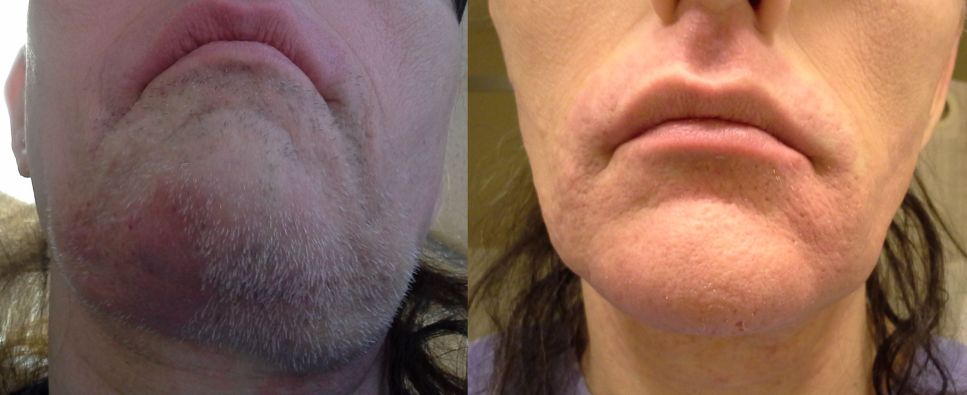
As promised, I am visually documenting my progress with E3000. I forgot to take an immediate pre-session before photo so I grabbed one at the 1.5 hour break mark. By that time the upper lip was largely cleared and work had also begun on the lower right side of the chin but it still conveys the amount of facial hair which was about the same as session one. I was told not to expect significant decrease in facial hair overall until we’ve completed at least four sessions but I will remark that there were more small “bald” spots on my face this time meaning less overall hair total.

E3000_session2_before_after_resized


The above were taken February 13th, 2014, in Dallas. The before photo was about 1.5 hours into the session and the after photo was immediately upon arrival back at my hotel around 5pm.

Second E3000 Session This Week!

My second E3000 session will be later this week. I’ll be sure to take some before and after photos and try this time to get an immediate after photo to show the usual swelling as a reference.

I got a very nice PM from one of my daughter-in-laws. She’s so very sweet. I really wish I could see my new grandson but I know that will never happen. It’s something I have to move past. But I am thankful that she at least acknowledged me this once.

I’m going to be going to Memphis, Tennessee in March to see a very very dear friend and hopefully a second who may be coming down from Madison, Wisconsin that same week. I’m excited!

The ethinyl estradiol continues to work and better than the prior estrogen form I was taking. I’m finally noticing more feminization occurring so this is a good thing!

A friend of mine finally joined Facebook. I hope I can make her presence there more comfortable.

Life proceeds apace. I’m gathering materials to have handy for my coming out to HR and management in early March.

Small steps, baby steps, but onward I go.